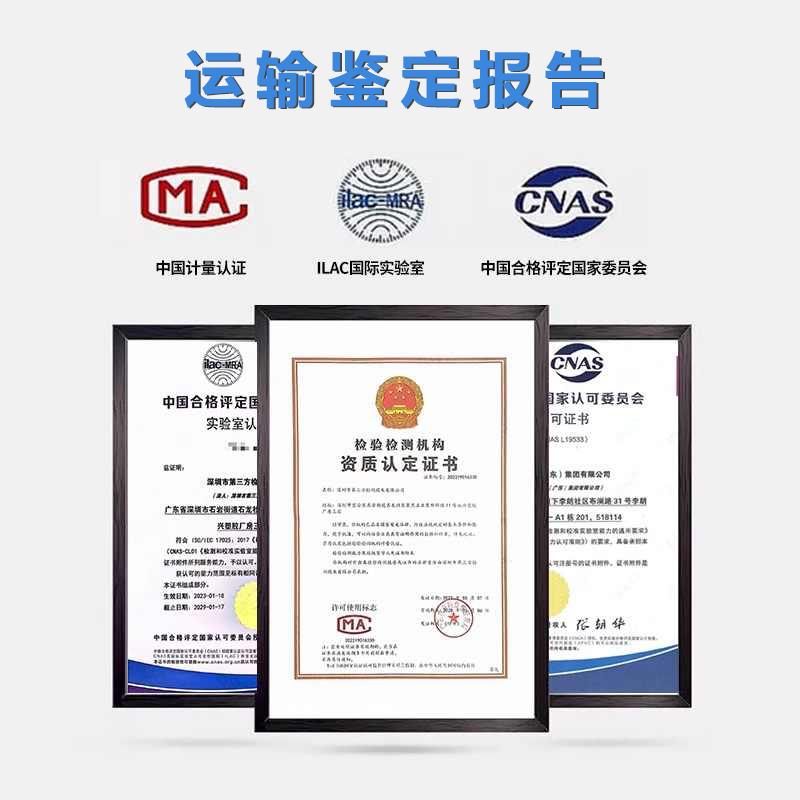
Geprüft und zertifiziert, reibungslos freigegeben für sichere und zuverlässige Qualität.
产品严格按照标准进行检测认证, 产品通关无压力品质更安全可靠


海运空运铁路陆运运输鉴定报告MSDS报告UN38.3报告【费用 周期 机构 流程】
海运空运铁路陆运运输鉴定报告MSDS报告UN38.3报告【费用 周期 机构 流程】
Verfügbarkeit für Abholungen konnte nicht geladen werden
一、运输鉴定报告(海运/空运/铁路/陆运)
定义与用途:运输鉴定报告由专业机构出具,评估货物在特定运输方式(海运、空运、铁路或陆运)中的安全风险,确保符合国际和国内法规.常见于危险品、化学品或精密设备运输,防止事故并满足海关要求。
核心内容: 包括货物性质, 包装完整性, 运输环境适应性及应急措施。例如,海运报告需考虑防潮和防震, 空运报告则注重气压变化影响.
申请流程:
准备材料:提供货物样品、成分表、包装设计图及用途说明.
选择机构:联系具备资质的第三方检测机构(如SGS、中国化工信息中心).
提交申请:填写申请表并支付费用,机构将进行测试或文件审核.
报告出具:通常需5-10个工作日,复杂货物可能延长.
注意事项:报告有效期通常为1年,过期需重新申请;不同运输方式(如海运与空运)要求可能差异显著,需针对性准备.
二、MSDS报告(化学品安全技术说明书)
定义与用途:MSDS是详细描述化学品危害、安全操作及应急处理的文件, 用于全球化学品管理, 确保生产, 运输和使用安全.
核心内容:涵盖16个标准部分, 包括化学品标识、危险性概述、急救措施、消防措施、泄漏处理、操作处置与储存、接触控制/个人防护、理化特性、稳定性和反应活性、毒理学信息、生态学信息、废弃处置、运输信息、法规信息及其他信息。
申请流程:
信息收集:整理化学品成分、用途、物理化学性质及安全数据.
选择服务商:委托专业机构(如SGS)编制,提供样品或数据.
编制与审核:机构根据标准编写, 并提交审核.
报告交付: 审核通过后, 获得符合国际标准的MSDS.
注意事项:MSDS需定期更新以反映最新法规;不同国家可能有特定要求,需针对性调整.
三、UN38.3报告(锂电池运输安全测试)
定义与用途:UN38.3是联合国针对锂电池运输的强制测试标准,确保锂电池在空运、海运等运输中的安全性,防止短路、过热或爆炸。
核心内容:包括T1-T8八项测试,模拟高度模拟、热测试、振动、冲击、外部短路、碰撞/挤压、过充电和强制放电场景。
申请流程:
样品准备:提供锂电池样品及相关技术参数.
选择实验室:联系具备UN38.3资质的实验室(如SGS).
测试执行:实验室按标准进行测试,记录数据.
报告出具:测试通过后, 颁发UN38.3报告,有效期通常为为1年.
注意事项:报告是锂电池运输的必备文件,缺失可能导致货物滞留;测试需在专业实验室完成,不可自行操作.
四、常见问题解答
F: 这些报告是否可以通用?
A:否。运输鉴定报告针对特定运输方式,MSDS适用于化学品管理UN38.3
F: 报告有效期是多久?
A:运输鉴定报告和UN38.3报告通常有效期为1年;M SDS需根据法规更新,无固定有效期,但建议定期复审.
F: 如何选择检测机构?
A: 优先选择具备国际认可资质 (如CNAS, ILAC)的机构, 确保报告全球通用.
1. Transportbewertungsbericht (See-/Luft-/Schienen-/Landverkehr)
Definition und Zweck: Ein Transportrisikobewertungsbericht wird von einer Fachorganisation erstellt, um die Sicherheitsrisiken von Gütern in bestimmten Transportarten (See-, Luft-, Schienen- oder Landtransport) zu beurteilen und die Einhaltung internationaler und nationaler Vorschriften zu gewährleisten. Er wird häufig beim Transport von Gefahrgut, Chemikalien oder Präzisionsgeräten eingesetzt, um Unfälle zu vermeiden und Zollbestimmungen zu erfüllen.
Kerninhalte: Dazu gehören die Art der Güter, die Unversehrtheit der Verpackung, die Eignung für die Transportbedingungen und Notfallmaßnahmen. Beispielsweise müssen Berichte über Seefracht Feuchtigkeit und Erdbebensicherheit berücksichtigen, während Berichte über Luftfracht den Fokus auf die Auswirkungen von Druckänderungen legen.
Bewerbungsprozess:
Vorbereitungsmaterialien: Bitte stellen Sie Warenmuster, eine Zutatenliste, Verpackungsdesignzeichnungen und Gebrauchsanweisungen zur Verfügung.
Institution auswählen: Kontaktieren Sie qualifizierte Prüfinstitute von Drittanbietern (z. B. SGS, China Chemical Information Center).
Antrag einreichen: Füllen Sie das Antragsformular aus und bezahlen Sie die Gebühr. Anschließend führt die Institution einen Test oder eine Dokumentenprüfung durch.
Ausstellung des Berichts: Dauert in der Regel 5-10 Werktage und kann sich bei komplexen Gütern verlängern.
Achtung: Die Gültigkeitsdauer des Berichts beträgt in der Regel 1 Jahr. Nach Ablauf dieser Frist muss ein neuer Antrag gestellt werden. Unterschiedliche Transportarten (wie See- und Lufttransport) können erhebliche Unterschiede in den Anforderungen aufweisen und erfordern eine gezielte Vorbereitung.
2. Sicherheitsdatenblatt (MSDS)
Definition und Zweck: Das Sicherheitsdatenblatt (SDB) ist ein Dokument, das detaillierte Beschreibungen von chemischen Gefahren, sicheren Arbeitsabläufen und Notfallmaßnahmen enthält und für das globale Chemikalienmanagement verwendet wird, um die Sicherheit bei Produktion, Transport und Anwendung zu gewährleisten.
Kerninhalte: Umfasst 16 Standardabschnitte, darunter Chemikalienkennzeichnung, Gefahrenübersicht, Erste-Hilfe-Maßnahmen, Brandschutzmaßnahmen, Umgang mit Leckagen, Handhabung und Lagerung, Kontaktkontrolle/persönlicher Schutz, physikalische und chemische Eigenschaften, Stabilität und Reaktivität, toxikologische Informationen, ökologische Informationen, Abfallentsorgung, Transportinformationen, regulatorische Informationen und weitere Informationen.
Bewerbungsprozess:
Informationssammlung: Chemische Zusammensetzung, Verwendung, physikalische und chemische Eigenschaften sowie Sicherheitsdaten organisieren.
Wählen Sie einen Dienstleister: Beauftragen Sie eine professionelle Organisation (wie z. B. SGS) mit der Aufbereitung und Bereitstellung von Mustern oder Daten.
Vorbereitung und Prüfung: Die Einrichtung bereitet die Unterlagen vor und reicht sie gemäß den Standards zur Prüfung ein.
Berichtserstellung: Nach Genehmigung ist ein Sicherheitsdatenblatt einzuholen, das internationalen Standards entspricht.
Achtung: Sicherheitsdatenblätter müssen regelmäßig aktualisiert werden, um den neuesten Vorschriften zu entsprechen; verschiedene Länder können spezifische Anforderungen haben, die entsprechend angepasst werden müssen.
3. UN38.3-Bericht (Sicherheitsprüfung des Transports von Lithiumbatterien)
Definition und Zweck: UN38.3 ist ein von den Vereinten Nationen festgelegter, verbindlicher Prüfstandard für den Transport von Lithiumbatterien. Er gewährleistet die Sicherheit von Lithiumbatterien beim Transport auf dem Luft- und Seeweg und verhindert Kurzschlüsse, Überhitzung oder Explosionen.
Kerninhalt: einschließlich acht Tests T1-T8, die Höhensimulation, thermische Tests, Vibrationen, Stöße, externe Kurzschlüsse, Kollisionen/Kompressionen, Überladung und erzwungene Entladungsszenarien simulieren.
Bewerbungsprozess:
Probenvorbereitung: Bereitstellung von Lithiumbatterieproben und zugehörigen technischen Parametern.
Labor auswählen: Wenden Sie sich an ein Labor mit UN38.3-Qualifikation (z. B. SGS).
Testdurchführung: Das Labor führt Tests gemäß den Normen durch und erfasst die Daten.
Ausstellung des Prüfberichts: Nach bestandener Prüfung wird ein UN38.3-Prüfbericht ausgestellt, der in der Regel 1 Jahr gültig ist.
Achtung: Der Bericht ist ein notwendiges Dokument für den Transport von Lithiumbatterien; sein Fehlen kann zu Verzögerungen bei der Warenlieferung führen. Die Prüfung muss in einem professionellen Labor durchgeführt werden und kann nicht selbst durchgeführt werden.
4. Häufig gestellte Fragen und Antworten
F: Können diese Berichte austauschbar verwendet werden?
A: Nein. Der Transportbewertungsbericht ist auf das jeweilige Transportmittel zugeschnitten, das Sicherheitsdatenblatt (MSDS) ist für das Chemikalienmanagement anwendbar, UN38.3 ist speziell für Lithiumbatterien vorgesehen und muss je nach Art der Güter und den Transportanforderungen ausgewählt werden.
F: Wie lange ist der Bericht gültig?
A: Der Transportbewertungsbericht und der UN38.3-Bericht sind in der Regel 1 Jahr gültig; das Sicherheitsdatenblatt muss gemäß den Vorschriften aktualisiert werden und hat keine feste Gültigkeitsdauer, es wird jedoch empfohlen, regelmäßige Überprüfungen durchzuführen.
F: Wie wählt man ein Testinstitut aus?
A: Bei der Auswahl von Institutionen mit international anerkannten Qualifikationen (wie CNAS, ILAC) sollte Priorität haben, um die globale Anwendbarkeit der Berichte zu gewährleisten.